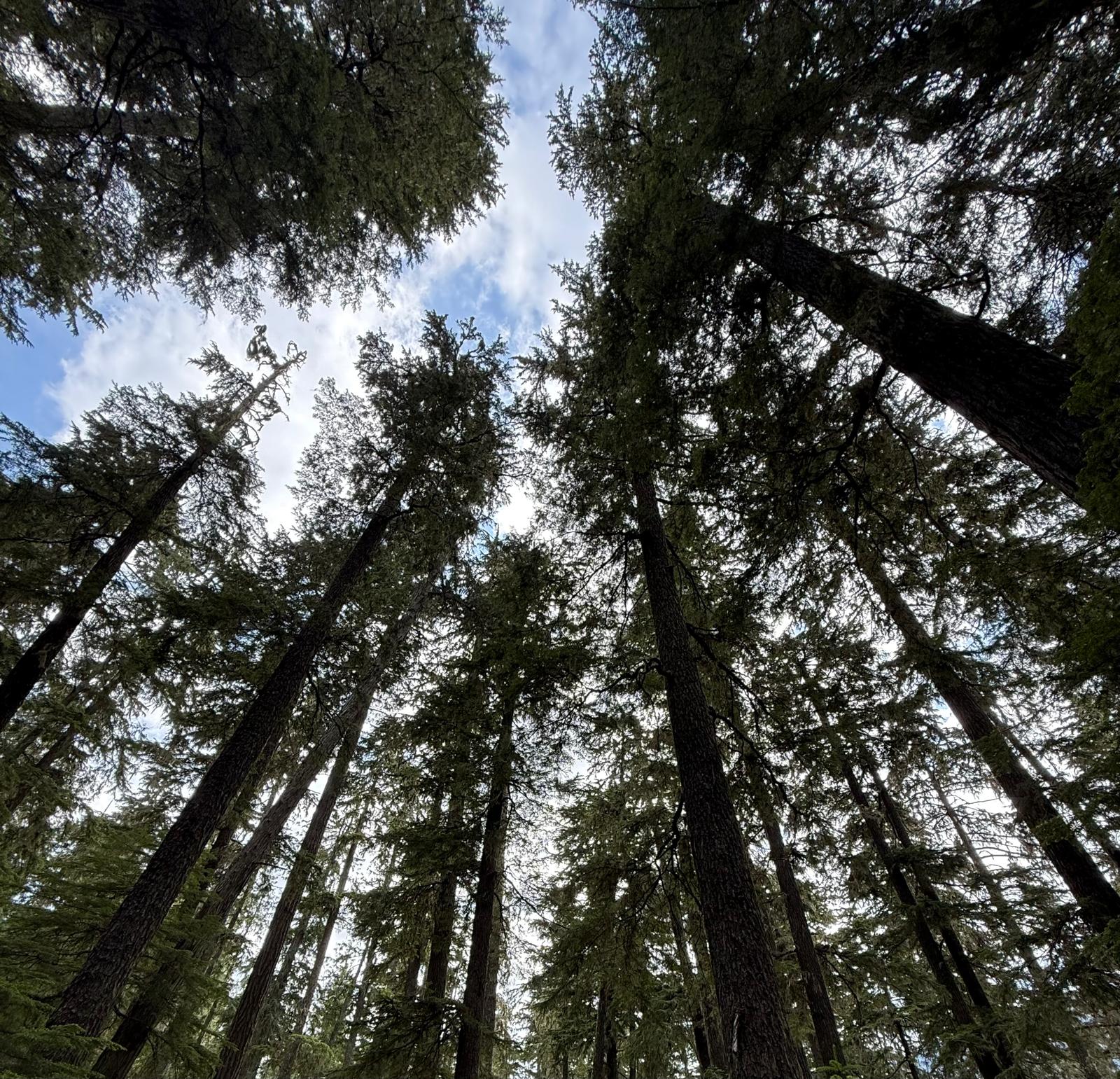
Photo by Billur Bektaş
Overview
Climate change has accelerated markedly from the Holocene to the Anthropocene, but vegetation may not respond at the same pace. This project examines whether the rate of vegetation change has kept up with climate change, and whether anthropogenic climate change has led to stronger climate–vegetation disequilibrium than Holocene climate variability.
To address this, I compare the pace of climate change with the pace of vegetation change across millennial and contemporary timescales. I analyze tree macrofossil records that capture Holocene vegetation dynamics and combine them with modern vegetation resurveys from Mount Rainier forests to quantify recent changes. By placing long-term paleoecological records and present-day observations within a common analytical framework, this project directly evaluates temporal lags between climate change and vegetation responses, and tests whether these lags have intensified under rapid anthropogenic warming.
Research questions
- How has the pace of climate change differed between the Holocene and the Anthropocene?
- How does the rate of vegetation change compare to the rate of climate change across these periods?
- Does anthropogenic climate change lead to stronger climate–vegetation disequilibrium than Holocene climate change?
- Are lags between climate and vegetation change larger under recent, faster climate change?
What I study in this project
Rates of change
I quantify and compare the pace of climate change and vegetation change across Holocene and Anthropocene timescales.
Climate–vegetation disequilibrium
I assess the degree to which vegetation change lags behind climate change, and how the magnitude of this disequilibrium differs between past and present.
Temporal context
By contrasting millennial-scale and contemporary dynamics, I evaluate how the acceleration of climate change alters the relationship between climate and vegetation change.
Collaboration
I conduct this project at ETH Zürich within the Plant Ecology Group with Janneke Hille Ris Lambers, with a focus on long-term vegetation dynamics and climate–vegetation relationships. The project is carried out in collaboration with Amy Angert (University of British Columbia), Peter Dunwiddie, and Agostina Torres (ETH Zürich).